No Shortcut to a Better Seat: Inside the Development of the Tolerance Stack CabMount™ for ISRI Airbases


There is a particular irony in spending more than half a million dollars building a purpose-built expedition rig capable of crossing continents, on pavement or off, and then spending every mile behind a seat that was never designed with your body in mind. That irony gets sharper if you have a bad back and a schedule that does not allow for recovery time. It gets sharper still off-road. More and more serious operators are repurposing these trucks for genuine off-road travel, and the moment the truck leaves pavement, a flat cushion and a flat seatback become a real problem. There is nothing to hold the driver in place. The scheel-mann Vario F Klima's adjustable side bolsters and lumbar support do not just make the seat more comfortable; off-road, they keep the driver planted in position when the terrain is doing its best to remove them from it. For a working driver, it is not an irony at all: it is a back injury waiting to happen, time off the road, a workers' compensation claim. The ergonomic shortcomings of an OEM seat are not a comfort issue in that context. They are an occupational health issue, and one that has not had a good answer for Freightliner drivers. Until now.
To be clear, the ISRI L3 Elite is a sophisticated piece of equipment. At the top of ISRI's commercial seating lineup, it offers more user-adjustable functions than most passenger car seats ever will: pneumatic ride height, fore-aft travel, adjustable ride firmness, and a scissor-lift airbase that genuinely isolates the driver from road shock in a way that has to be experienced to be appreciated. Higher-spec ISRI configurations add heated and ventilated cushions, adjustable lumbar support, and seat angle control. The engineering in the suspension system alone would surprise most people who have never sat in one. What the ISRI lineup does not offer, at any trim level, is an orthopedic seat. The cushion geometry, the bolster shape, the ergonomic profile of the seat itself: none of that changes based on how many switches are on the side of the seat base. It is also worth noting that the ISRI pneumatic airbase is not exclusive to Freightliner, and the L3 Elite is not the only model in the lineup. The same airbase interface appears across a broad range of commercial truck platforms, which means the problem this product solves extends well beyond one truck brand and one seat model.
The issue is not the functions. It is the seat itself. The cushion, the bolstering, the ergonomic profile: all of it is sized and shaped for the statistical commercial truck driver, a person who trends considerably larger than the average expedition vehicle owner. For a slim 5'7" driver spending weeks behind the wheel of a Freightliner, especially off-road, the geometry simply does not fit. There is no meaningful side support to hold the body through corners, no contouring that accommodates a smaller frame, and no ventilation to manage the heat buildup that comes with long days on the road. The airbase is excellent. The seat sitting on top of it is a different conversation.
That gap is exactly where scheel-mann's Vario F Klima belongs. The German seat manufacturer has built a reputation in the overlanding and expedition community that is difficult to overstate, and the Vario F Klima, with its individually adjustable side bolsters, heated and ventilated cushions, deep lumbar support, and upholstery quality that belongs in a luxury car rather than a work truck, is broadly considered the benchmark for what a serious long-distance driver's seat should be.
The problem is getting one into a Freightliner.
The Problem Nobody Had Solved
The 114SD's factory seating system is not designed with upgradeability in mind. The ISRI L3 Elite mounts to the cab floor through a pneumatic airbase, a scissor-lift suspension system that absorbs road shock and allows the driver to adjust ride height. That airbase is a genuinely good piece of engineering. Removing it entirely and starting from scratch would mean giving up proven air suspension that works well and is already integrated with the truck's air system.
But the seat itself (the part the driver actually contacts) bolts to that airbase through an interface that is specific to ISRI products. No other seat manufacturer makes a drop-in replacement for just the seat. The controls for the airbase's pneumatic height adjustment and horizontal fore-aft slider are integrated into the seat's side panel. The whole system assumes you are using an ISRI seat on an ISRI base, because that is the only combination that has ever been offered.
When a 114SD owner with a Bliss Mobil expedition body contacted scheel-mann USA in late 2025 asking whether it was possible to replace his factory seats with the Vario F Klima, the answer from scheel-mann was honest: the seat itself was certainly available, but a proper mounting solution for the Freightliner platform did not yet exist. As far as scheel-mann USA could confirm, no scheel-mann seat had ever been installed in a semi truck at all. What did exist was us: Tolerance Stack, a scheel-mann dealer with a background in precision manufacturing and a willingness to take on exactly the kind of problem that does not have an existing answer.
scheel-mann connected the customer to us, and the conversation that followed laid out the scope of what would become a five-month engineering project.
Taking the Problem Apart, Literally
The first thing we did was buy a seat.
A fresh ISRI L3 Elite sourced through a local Freightliner dealer in Oregon. The rationale was straightforward: no engineering work worth doing starts from a guess. To design an adapter between the ISRI airbase and a scheel-mann seat, you need to understand exactly what you are adapting: the geometry, the interfaces, the control locations, the dimensional constraints, and the things the factory documentation does not tell you.

Worth stating plainly: none of us had ever been inside a semi truck before this project. There was no prior ISRI seat knowledge in the shop, no institutional familiarity with the Freightliner cab or its systems, and nothing to shortcut the learning curve. Every dimension came from measuring. Every assumption had to be confirmed. The teardown was not just a logical first step; it was the only way in.
Before any teardown work could begin there was a more fundamental problem: the ISRI airbase is an air-operated system, and with no truck to plug it into, it would not function. The base requires approximately 90 PSI of supply air to operate. We fabricated a custom push-to-connect adapter that converted the seat's pneumatic supply port to a standard Schrader valve, allowing a shop air line to feed the system directly. That fitting let us pressurize the base, raise the scissor mechanism, operate the height adjuster, and access hardware that would otherwise be locked under load.


What emerged from the teardown was both encouraging and clarifying. The pneumatic airbase itself (the scissor suspension, the air cylinder, the fore-aft slide mechanism) was genuinely worth keeping. It is the part of the factory system that does actual work, and it does that work well. The seat cushion and shell that normally sit on top of it, on the other hand, confirmed everything the customer had communicated about wanting something better.
The teardown also established the critical interface geometry: the six mounting points where the seat meets the airbase, the height available between the base and the cab floor at various suspension positions, and the physical location of the pneumatic controls that would need to remain accessible no matter what seat went on top.
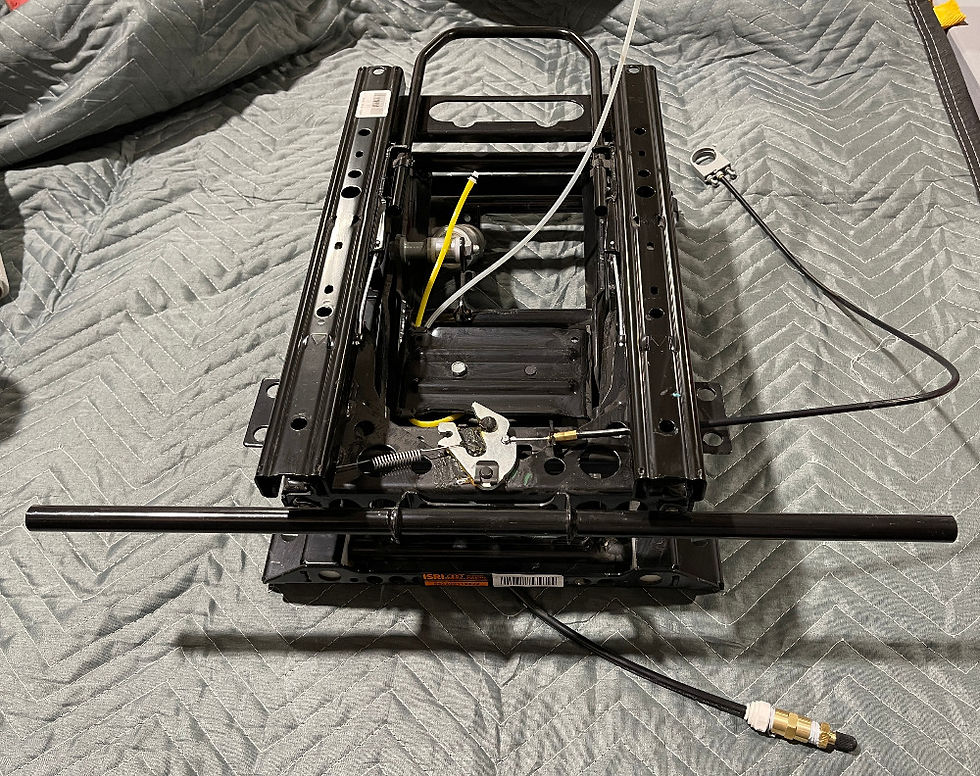
The seatbelt anchor, a cross pipe at the rear of the airbase, also required attention. On the reference unit that pipe was offset to one side and had to be removed and flipped 180 degrees to clear the prototype adapter. On the customer's truck the same pipe was welded in place but centered rather than offset, and it cleared the production mount without any modification. One of the few production variations that went in the right direction.
Disassembly also confirmed that the airbase does not sit flat on a floor in the truck; it mounts to raised pedestals in the cab that keep it stable and at the correct operating height. To replicate that on the bench, we fabricated an aluminum base plate that served as the test fixture for the entire development process: every adapter revision, every fit check, and every function test was run on that plate before anything went near a real truck.

The customer's truck also prompted a check on one specific variable: whether the factory seats were equipped with OPS sensors, occupant presence sensor pads embedded in the seat cushion and tied into the truck's safety systems. The mount design itself is unaffected either way. We have transferred pressure sensor pads and thermistors between seat platforms before, and an OPS pad would have been removed from the ISRI cushion and relocated into the Vario without complication. In this case the check came back negative. No OPS sensors. But it was worth confirming.
Designing the Adapter
The core engineering challenge was this: design a mount that bolts to the ISRI airbase using the factory attachment points, accepts a scheel-mann Vario F seat, keeps all pneumatic controls accessible to the driver, and does all of this cleanly enough that the finished installation looks intentional rather than improvised.

The solution we developed has two primary components.
The main adapter plate is a precision-machined steel structure that bridges between the airbase's top interface and the scheel-mann seat's mounting pattern. It is powder-coated black and engineered to a strict height requirement: the finished seat position had to match the factory seat height exactly. The driver's sightlines, mirror adjustments, and ergonomic relationship to the steering wheel are all calibrated to that height, and an adapter that raised the seating position even meaningfully would create problems no amount of mirror adjustment could fully correct. Every millimeter of stack height was accounted for.
The scheel-mann Vario F is also a considerably heavier seat than the ISRI cushion it replaces. That weight is the cost of the construction quality and materials that make it worth installing in the first place. Fortunately, the ISRI airbase was not engineered for a lightweight driver. It was designed for the full range of commercial operators, and its pneumatic lifting capacity reflects that. The additional mass of the scheel-mann seat is well within what the airbase handles without any modification.
The second component is what we call the function plate: a matched pair of flat anodized aluminum plates that mount on either side of the adapter. One is a structural blank. The other carries all of the relocated OEM seat controls: the pneumatic height adjustment, the horizontal fore-aft slider, and the scheel-mann climate controls (heat and ventilation, each with low, off, and high settings). On the factory ISRI seat, those controls are built into the seat shell and leave with it when the seat is removed. The function plate gives them a new home on the adapter itself, where they remain accessible to the driver regardless of what seat sits above.
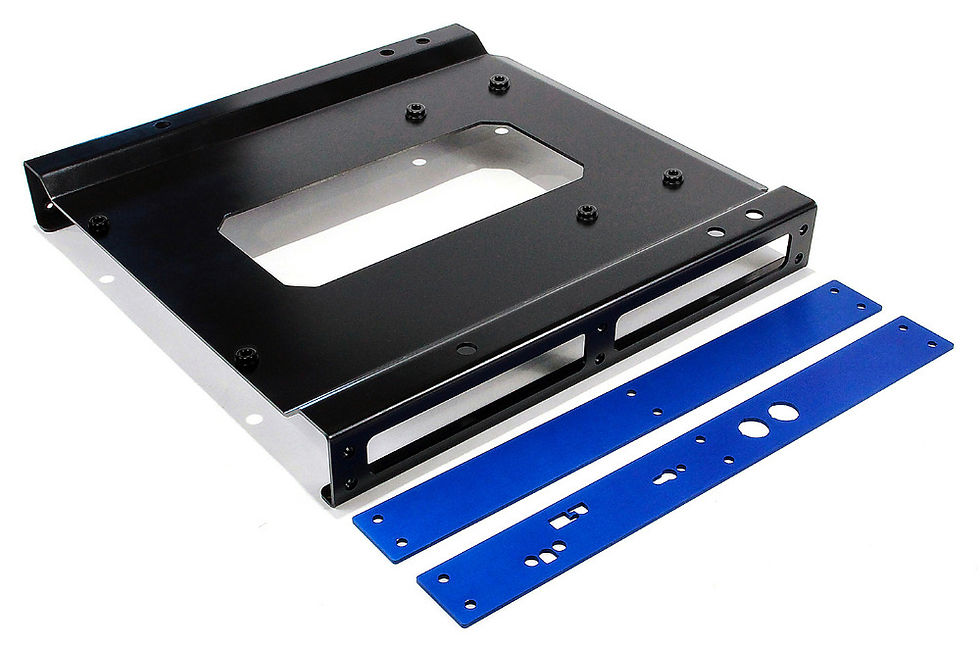
The function plate design is ambidextrous by intent. It can be installed for left or right hand operation before the seat goes in, and that choice has nothing to do with how the original ISRI seat was configured. The 114SD uses the same airbase platform for both driver and passenger positions, and a single function plate design handles either without modification.
The anodize color of the function plates is specified by the owner. For this build, the customer's 114SD wears a striking cobalt blue that defines the look of the entire rig, and the function plates were anodized to match. It is a detail that turns a utilitarian bracket into something that looks like it was always supposed to be there.

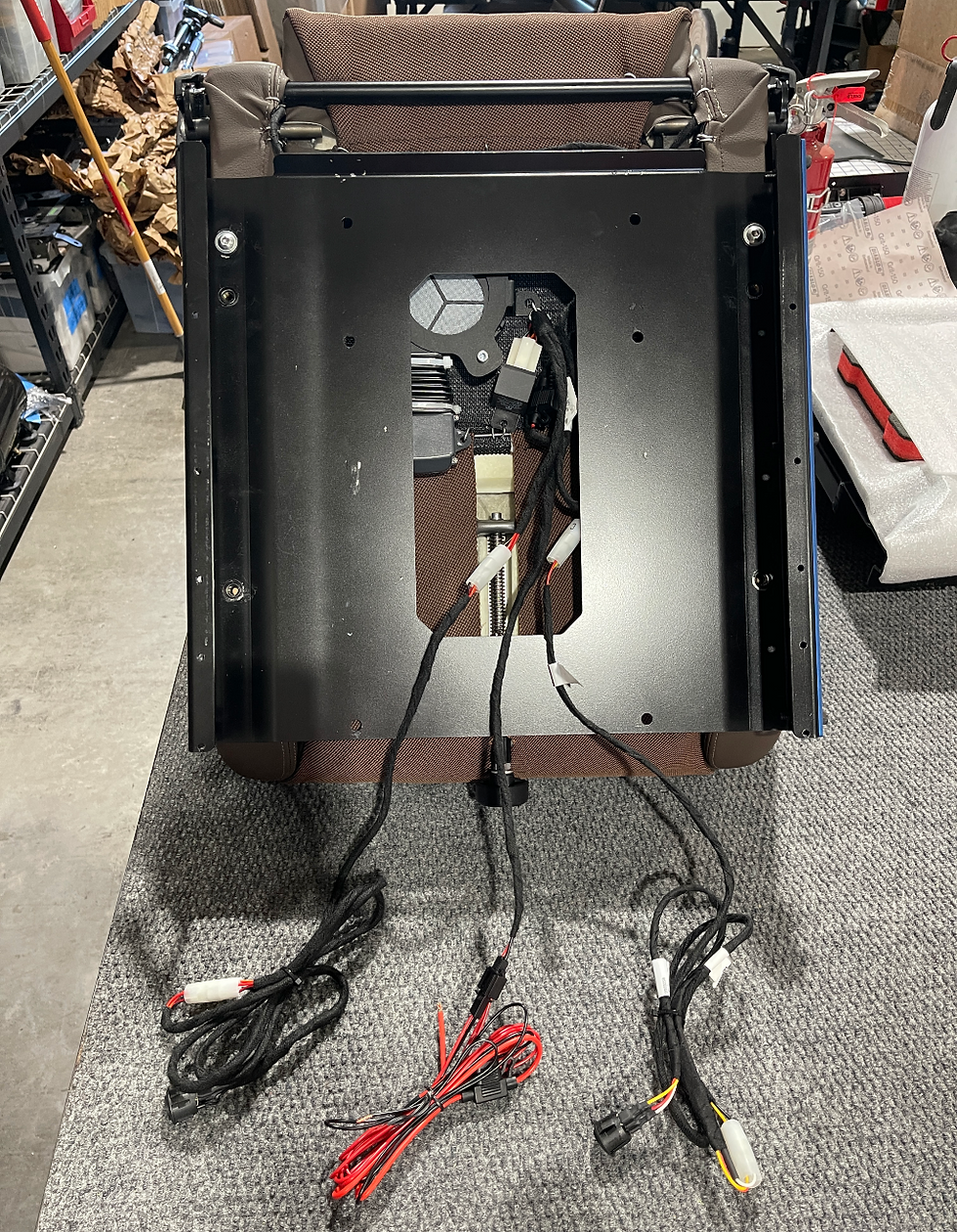
The Klima version of the Vario F carries additional wiring compared to a heat-only seat: the ventilation circuit adds a second set of connectors alongside the heating circuit. The adapter plate's central cutout keeps those harnesses accessible while the plate does its structural work. Everything routes through and below the adapter to the function plates and the truck's electrical system.
The Documentation Effort
Parallel to the hardware development, we were building something that tends not to get talked about in product announcements but represents a substantial portion of the actual work: the installation guide.
The original plan was not for us to do the installation at all. The customer had a shop in Colorado lined up to do the work, which meant the documentation was not optional: it was the whole point. A shop that had never seen this system needed something precise enough to follow without us in the room. That was the brief. The guide had to stand on its own.
As it turned out, the customer later decided he wanted us to perform the install ourselves, which is how the project ended up in Portland. But the documentation effort had already been set in motion, and the standard it was built to did not change. At that point this was not yet conceived as a product. We were not certain there was broader demand for it. The guide was written for one shop, for one truck. What it became is something else.
We developed that guide over the course of the project, building it out as the engineering progressed. Rather than relying on photographs alone, the guide was built around original line drawings, technical illustrations of each major step produced specifically for this platform, that show component relationships and orientations clearly enough to remove ambiguity from the process.

The guide was drafted before installation day and shared with the customer and scheel-mann in the days leading up to the install. After the actual installation, we spent approximately fifteen additional hours updating the guide based on everything the real-world install revealed, producing what became the final version now included with every adapter kit.
That version reflects what can only be learned from physically doing the job: the specific sequence that avoids clearance conflicts, the fastener details that the pre-install documentation had to estimate, and the minor variations between individual trucks that an installer needs to anticipate.
Two Revisions and a Production Run
The adapter went through two design revisions before production parts were cut.
The first revision addressed fit and clearance issues identified during bench testing on the reference airbase. The geometry of the main plate, the positioning of the function plate mounting bosses, and the routing of the control wiring all required adjustment before the design was clean enough to commit to production materials.
The second revision refined the function plate itself: the control layout, the switch cutout geometry, and the way the plate interfaces with the scheel-mann seat's undercarriage. Getting that interface right on a bench required working from measurements and factory documentation for both the ISRI base and the scheel-mann seat, none of which was written with this specific combination in mind.
By the time production mounts came back from fabrication, the adapter had been bench-tested on the reference airbase and pre-fitted. The first time the complete system (airbase, adapter, and scheel-mann seat) came together as a unit was on the bench, with shop air plumbed in through the custom Schrader fitting. The height adjuster worked. The fore-aft slide worked. The Klima controls functioned. Everything that needed to be confirmed before the system went near a real truck was confirmed.
Install Day: Fourteen Hours at scheel-mann Portland
On May 15, 2026, we drove to Portland and spent fourteen hours installing two seats.
The install took place at scheel-mann USA's facility, a warehouse space in Northeast Portland where the customer's truck had been staged the evening prior, the customer and his son having driven in from Montana. scheel-mann offered the space and made their tools available as needed. The actual installation was a solo effort.
What made fourteen hours necessary was something that cannot be fully anticipated from a reference seat purchased at a dealership: the reference and the reality are never quite the same. Your install time should be around half of that because, as it turned out, the ISRI seat we had purchased for development was a year older than the seats actually installed in the customer's truck. Individual trucks, even within the same model line, differ in ways the spec sheet does not capture. Slight differences in seat mounting geometry, in the routing and length of wiring harnesses, in how the factory seat shell had been positioned relative to the base. None of these required redesigning anything. All of them required adapting in real time.

Two discoveries on install day were worth noting. The customer's seats were spec'd with seat heat, but the feature had never worked. A quick look at the floor harness revealed why: the ground pin terminal had no mating wire connected. The seat heat was never going to function as delivered. We repaired it while we were in there.
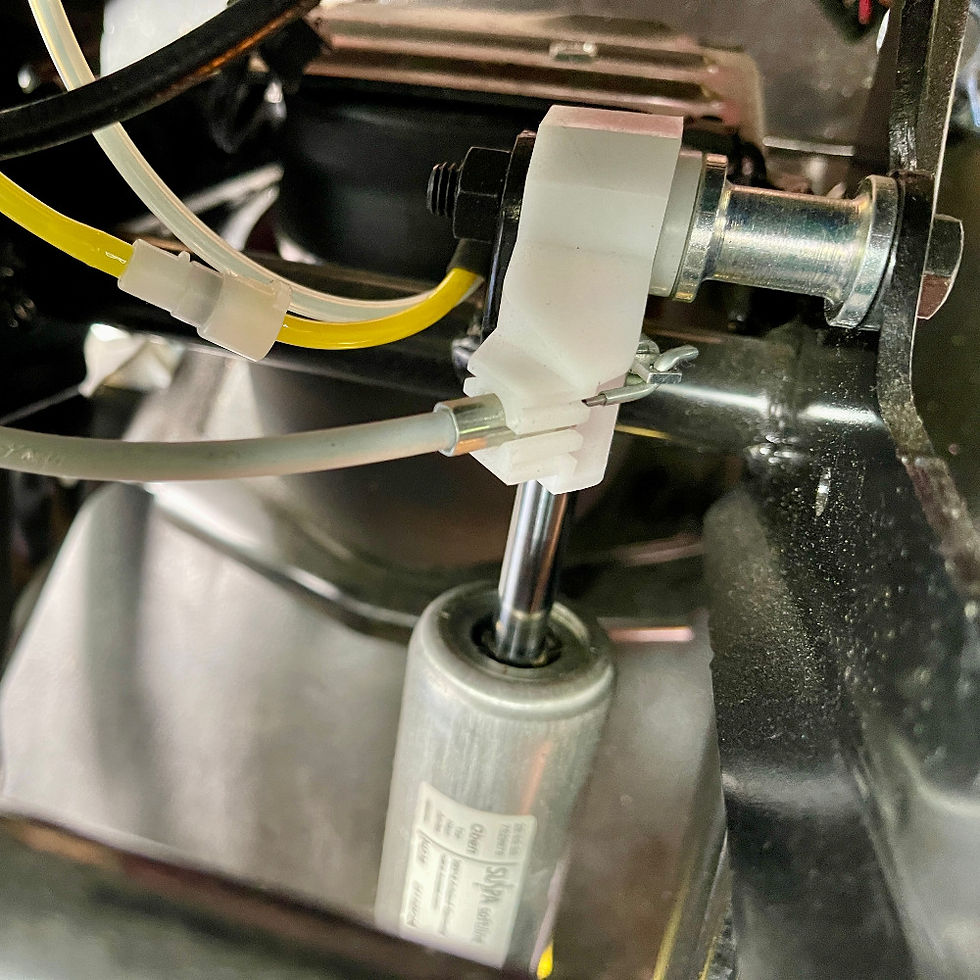
The second surprise was a seat damper on the customer's ISRI bases that did not exist on our reference unit: a dedicated pneumatic shock absorber with its own actuator handle for adjusting damping on the fly. We had no idea the feature existed until we were standing in front of the truck. Rather than leave it non-functional, we developed a solution on the spot: designed a modified function plate in SolidWorks, fabricated a 3D printed spacer block to establish the correct mounting geometry, and retained the OEM damper handle in a clean, accessible position. It worked. It is now part of the documented install for trucks equipped with that feature.
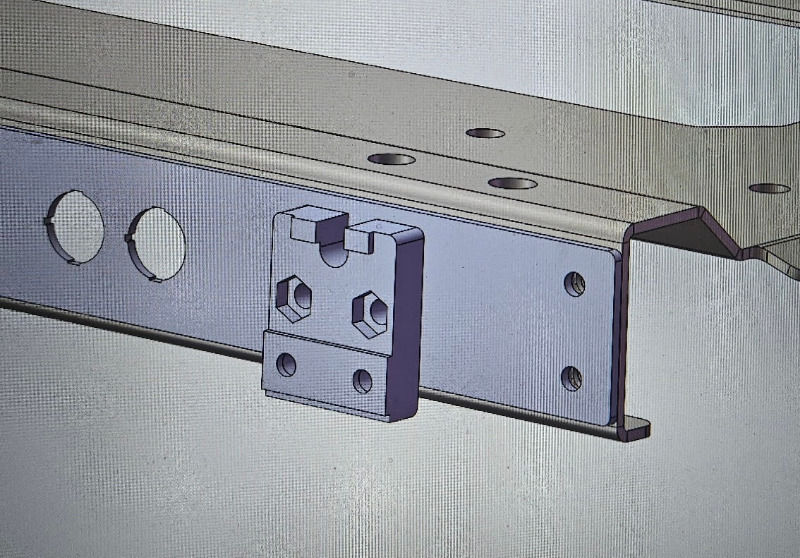

Every step of the installation was documented: each variant, each adaptation, each detail that differed from what the pre-install guide had anticipated. That documentation became the raw material for the guide's post-install revision.
The passenger seat installation followed the driver seat and incorporated everything learned from the first. At the end of the day, both seats were installed and functional, pneumatic adjustment working, climate controls wired and operating, upholstery unscathed.
The difference between the factory ISRI seats and the installed scheel-mann Vario F Klima is not subtle. The customer, writing afterward, put it simply:
"the new scheel-mann seats are truly incomparable to the generic standard factory-installed ones. The support is all-around comprehensive and of superb quality; upper and lower backs, flanks, thighs, hips, the entire body."
What the Product Is
The CabMount™ is the result of that process: five months of engineering, two bench revisions, a fourteen-hour real-world installation, and a documentation effort that turned the knowledge gained into something transferable.
The adapter keeps the ISRI pneumatic airbase in place. Everything that makes the factory suspension system work (the air cylinder, the scissor mechanism, the height adjustment, the fore-aft slider) remains in the truck. What changes is the seat. The CabMount™ provides the interface between that airbase and a scheel-mann Vario F seat, along with the function plates that consolidate all seat controls (pneumatic height, horizontal slide, heat, and ventilation) into clean, accessible panels.

The function plates are anodized aluminum, color specified by the owner. The main adapter is powder-coated black. The complete system is designed to be installed by a qualified shop working from the included documentation, the same documentation we built from the ground up for this platform and refined through the first real installation.
The CabMount™ is available now through the Tolerance Stack website. It fits the Freightliner 114SD and Cascadia platforms, plus other truck manufacturers and models, that share the ISRI L-Series airbase, covering the commercial truck foundation that an increasing number of serious expedition vehicles are built on.
For Freightliner owners who have been waiting for a path to a proper seat upgrade, the wait is over.
A Note on Compatibility and Installer Expertise
We know this seat, this adapter, and this installation intimately. We engineered the CabMount™ from scratch, built the documentation from zero, and have performed the installation firsthand. That is where our expertise is focused.
What we are not is authorities on ISRI seating as a category or on semi-truck cab configurations as a whole. ISRI produces a wide range of airbases across many model lines, and commercial truck builds vary considerably — in options, in model year, in how individual trucks left the factory. We developed the CabMount™ against specific hardware and have refined it through real-world installation, but we cannot account from a distance for every configuration variation that may exist in the field.
If your truck differs from the documented configuration in any meaningful way, that is something the installing shop needs to assess hands-on. We are glad to consult — to share what we know about the engineering, offer suggestions, and work through questions — but the final determination of fitment has to be made by someone standing in front of the vehicle. We do not guarantee fitment for ISRI configurations outside the scope of what we have directly verified, and we would not want a remote assumption from us to substitute for an informed evaluation on-site.
If you are unsure whether your setup falls within that scope, contact us before you order. That conversation costs nothing and will save everyone time.
ISRI is a registered trademark of ISRI GmbH. Tolerance Stack is not affiliated with, endorsed by, or connected to ISRI GmbH in any way. All product and company names are the property of their respective owners.
#Freightliner #Freightliner114 #Cascadia #FreightlinerCascadia #semitruck #classatruck #bigrig #commercialtruck #overlanding #expeditiontruck #expeditionvehicle #truckbuild #overlander #semioverlander #expeditionrig #offroadtruck #seatsupgrade #customfabrication #truckupgrade #drivercomfort #ergonomics #madeinUSA


Comments